
At our February meeting we had a very interesting and thought provoking talk on how AI can be used to plan observing sessions, but also to clean up images with missing data and even generate pictures of objects in our night sky.
Generative AI can produce some fantastic astronomical images, and on first glance they look very credible. However, on closer inspection there are differences, and sometimes new stars or extra details appear in the artificially generated image.
Take these two images – the left taken through an amateur telescope and the right generated by ChatGPT.
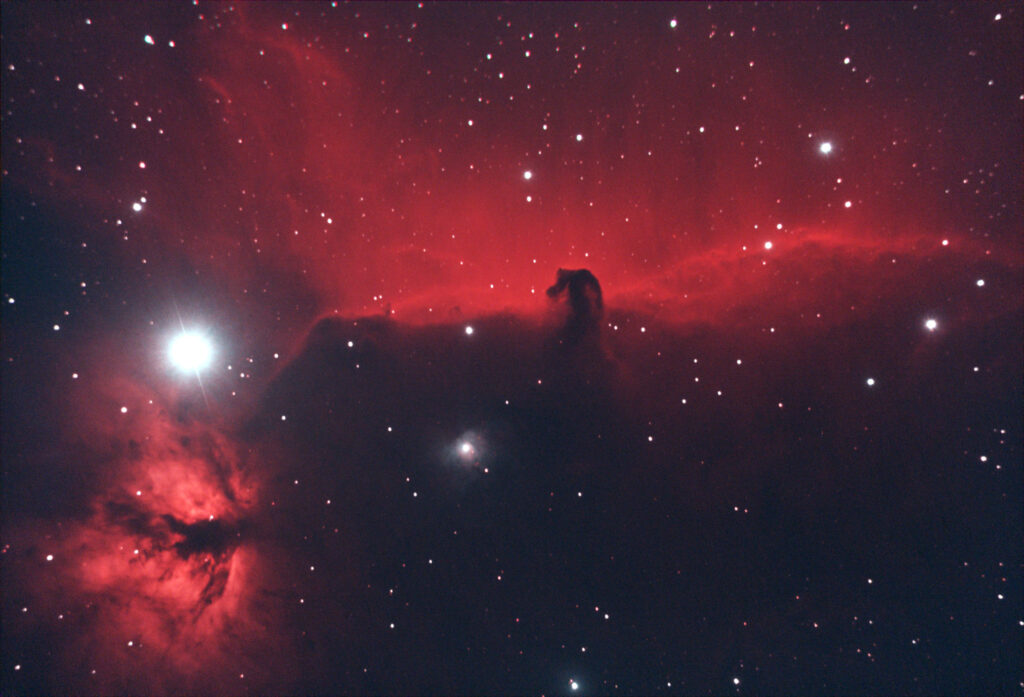
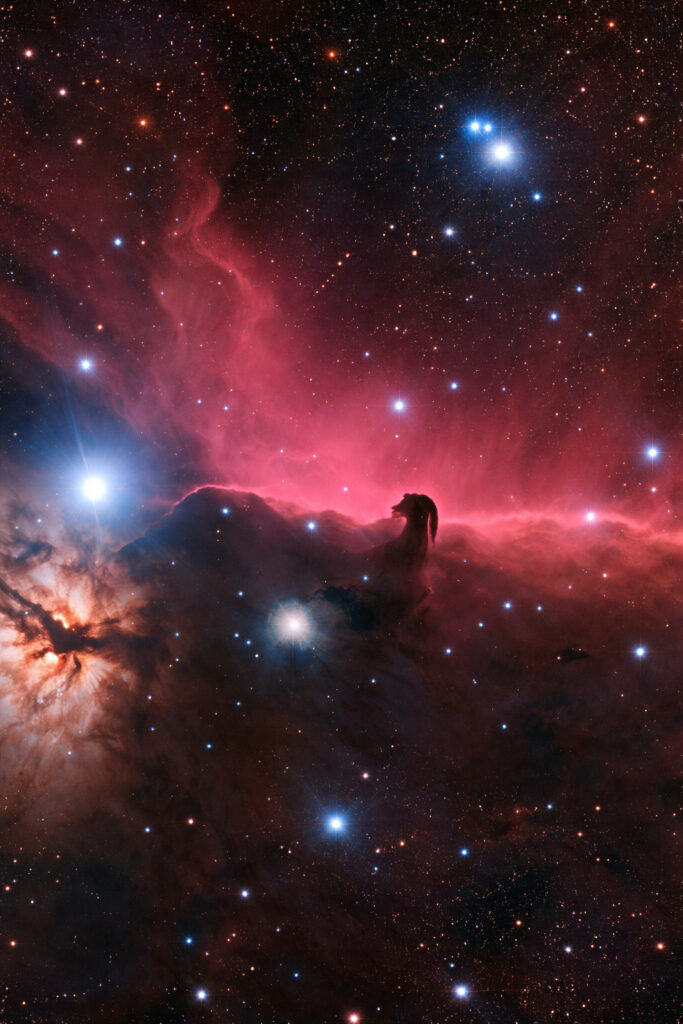
Although the views are not the same, looking at the stars around the horse head itself, you can see some stars are missing and others are brighter or even added extras in the AI image.
Social media has a tendency to use AI generated images in content related to astronomical events like aurora, meteor showers or eclipses, but they are very often unrealistic and over dramatic to grab the reader’s attention.
Case in point the “Planetary Parade” or “Planetary Alignment” on 28 February 2026, and here are a couple of examples. The left image from Google Gemini showing a “planetary line up” and the right image from ChatGPT showing the “planetary alignment on the 28 February”
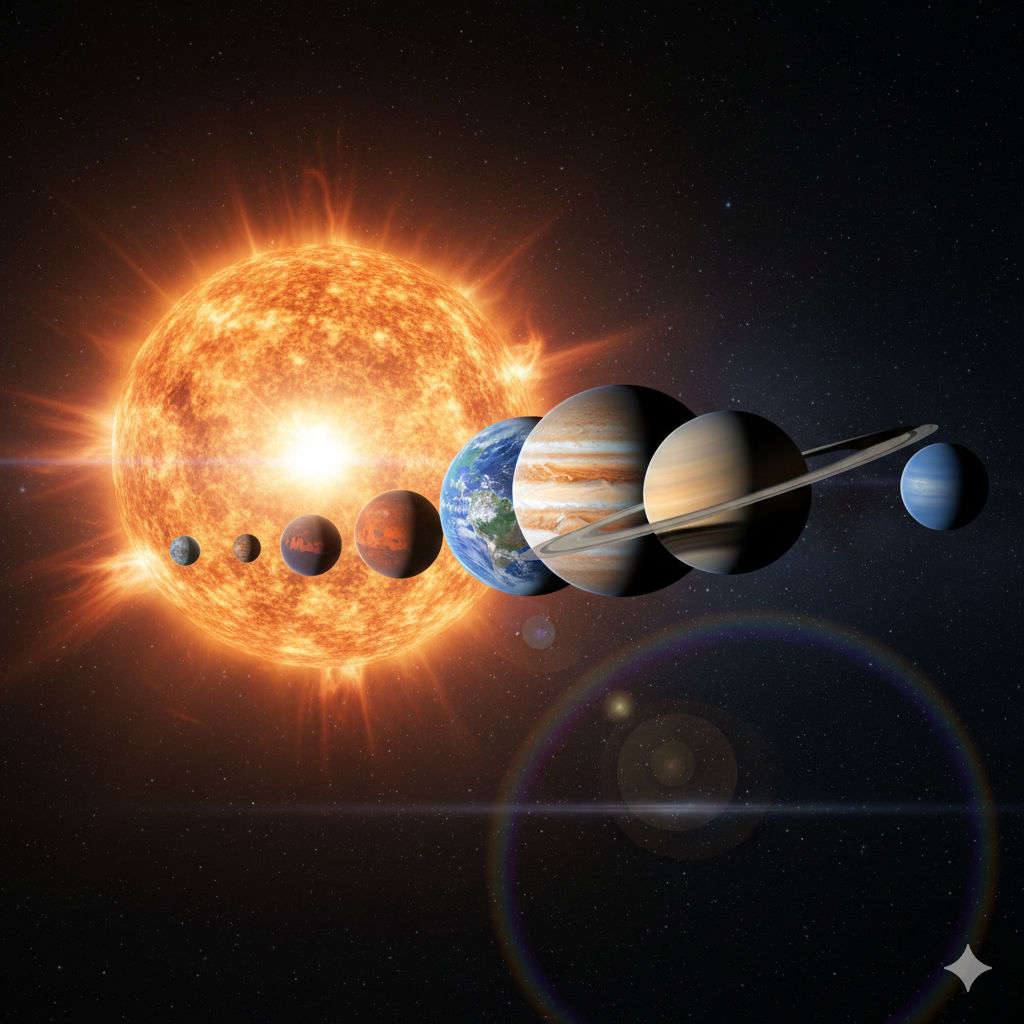
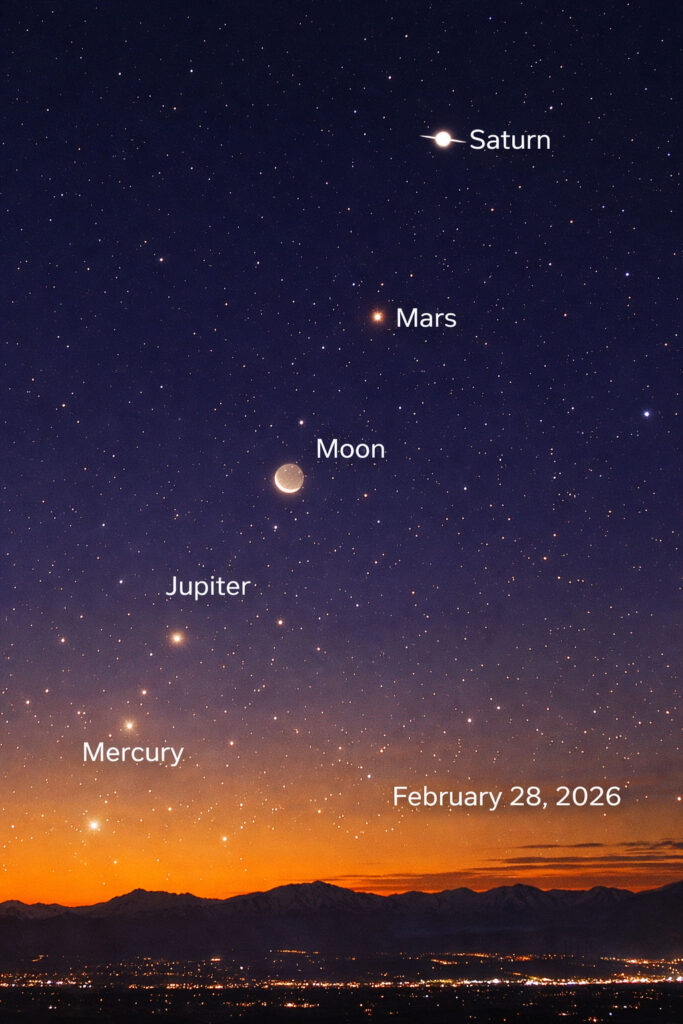
A reality check………
The planets aren’t lined up (even in the wrong order) as shown in the left image, and we won’t be able to see them in one small area of the sky. The image on the right has errors – Saturn will be close to the Sun, the Moon is the wrong place and Mars is not in our night sky at the moment.
Simply put, there isn’t really an “event”on the 28th of February. At the moment six of the planets are on the same side of the Sun and appear in our evening sky. The appear to be in a line because we are looking at the plane in which all the planets orbit the Sun.
So what will we be able to see?
The graphic below was created with Stellarium a free app that is very useful for exploring the sky and planning observing sessions. It shows the view to the South-West at 6pm on the 28th of February as viewed from around Farnham.
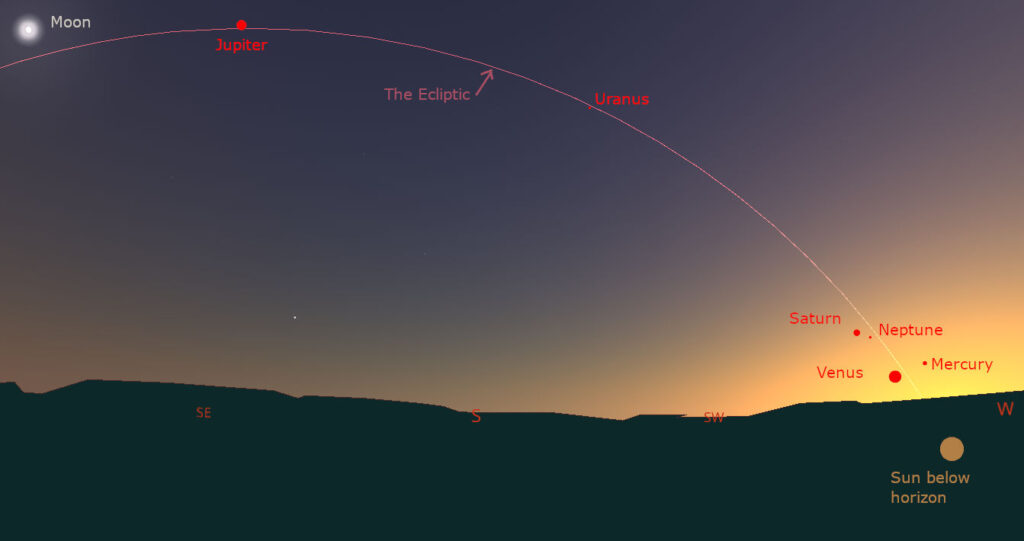
- Venus will be following the setting Sun with Mercury close behind. By the time it’s dark enough to see them, they will most likely be below the horizon.
- Saturn and Neptune will be following Venus and will also be very close to the horizon as the Sun sets. To have a chance of spotting Saturn, the horizon to the West needs to be free of trees, building or hills.
Important: For safety and to protect your eyesight, never attempt to look for any object close to the Sun using a telescope or binoculars until after the Sun is below the horizon.
- Uranus and Neptune are very hard to spot even with a large modern computer-guided telescope.
- The star of the show (no pun intended) is Jupiter which will be almost overhead and easily visible with the naked eye once it gets dark. A good pair of binoculars will give views of Jupiter’s larger moons and it is fascinating to see them change position hour-to-hour, night-to-night.
The graphic also shows the Ecliptic, the path of the Sun as it crosses our skies. It’s really a projection of the Earth’s orbit traced onto the sky. All the planets orbit in roughly the same plane and the planets in our night sky follow the Ecliptic. That’s why the planets are sometimes said to be in a line.
So this is not a one-night-event and the planets will be in our skies for some weeks to come. Well worth looking for Jupiter…..easy to spot by eye, fascinating in binoculars and spectacular in a telescope!
Written By: Danny Thomas